
As the world navigates through these uncertain times, we think this is an opportune time to publish a series of
pieces written by staff that reflect our perspectives and how we characterize the future, while keeping you
upto-date on the asset management business of HFR.
COVID destruction brings a shift to Hedge Funds
These times are certainly challenging for everyone. As we find ourselves impatiently waiting to go back to normalcy,
the woes of COVID-19 have resulted in fear gauge levels beyond what we have seen since the 2008 housing market
crash. As we see every day in the media, the spread of the virus has had a profound impact not only on our health
and economy, but our state of mind. Media reports have suggested that the virus has killed thousands of people so
far in the U.S. with the expectation that we have not reached our peak. And although we are not quite there yet, the
U.S. has shown great resilience through its history of crises.
In terms of the market, the turmoil of COVID-19 has: (1) affected all supply chains, (2) prompted the Fed to cut the
Fed Funds rate twice in March (now @ zero), and (3) pushed the Fed to initiate a $700 billion quantitative easing
program and Congress to pass a $2 trillion government stimulus package. Bleak unemployment forecasts are expected to
pummel the economy further. At the same time, a price war between oil producing countries has dropped oil prices to
$20 a barrel – a first in 20 years. A complete bloodbath.
We are seeing levels in the VIX higher than they’ve been since 2008 – a 300% YTD change (VIX currently @ 56), 10-year
yield falling to 0.68% flattening the curve, and retraction of the equity markets (S&P @ 2,584 close as of
3/31/2020) down 20% YTD. It is unclear if a COVID-19 vaccine (potentially Chloroquine and Hydroxychloroquine) will
be available this year, and if so, in massive quantities to be effective – very unlikely. We would hope for a
V-shape recovery, but we are under the belief that a L-shape recession would not be a surprise.
In this bear market selloff, portfolios that were overweighted equity have seen most performance vanish. We can
certainly anticipate a long recovery in the equity space, and even more so with dividend cuts through the end of the
year. However, we also see potential in alpha generating and capital protecting strategies going forward. So, we
believe this is an opportunistic time to reallocate capital back into hedge funds.
Hedge funds have been generally under allocated the past ten years, and we expect to see a comeback as hedge fund
managers have experience trading through a volatile market and over various market cycles. We have spoken with our
hedge fund managers who so far have been able to navigate the uncertain landscape and believe there are many
opportunities with motivated sellers, higher discounts, volatile spreads, great price dislocations, and other
high-conviction trades.
While institutions reevaluate their single manager holdings, a swift strategy shift can be made to an investable
hedge fund index such as the HFRX. The HFRX Indices are one of the longest-lived family of investable indices in the
market – funded since 2003. Institutions can use either of the three investable segments: (1) Liquid Alternative
UCITS Constituents, (2) Hedge Fund Constituents, or 3) SMA’s. Information on the HFRX benchmarks can be found at https://www.hfrx.com.
Index tracking vehicles are cost-efficient, can be used for liquidity needs, and a smart way to increase hedge fund exposures in your total portfolio with global, strategy, or sub-strategy index allocations.
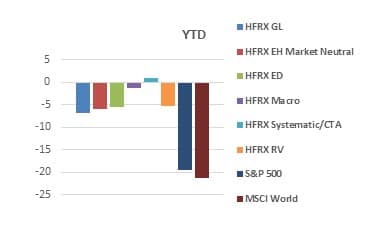
With overall markets declining in double digits, the HFRX Global Index had declines in the single digits, and Macro
Systematic/CTA Index was in positive territory through March and YTD.

In these times, we think it’s important to reevaluate risk factors, liquidity, and performance to achieve your
institution’s investment goals. It’s also a perfect time to review your existing cash overlay strategy that can meet
your short-term cash needs but continue to provide relative outperformance.
The political apparatus has started to implement many tools for a softer landing of the economy, but the real
question persists if balance sheets have the wherewithal to shoulder a long deep slowdown if one is to occur. We, as
always, will continuously monitor and evaluate the state of the overall market, but we believe that the good times
have rolled off, and it is now time for everyone to roll up their sleeves.
Michael Arenibar, President
HFR Investments, LLC
marenibar@hfr.com
A downloadable copy may be retrieved here.
Share this article on social media!
Disclaimer: This article does not constitute an offer, or a solicitation of an offer, to buy or
sell any securities, and is intended for informational purposes only. Any offer of an HFR Fund will be made solely
by a Confidential Offering Memorandum, and then only to qualified purchasers. This document is confidential and is
intended solely for the information of the person to whom it was delivered. It is not to be redistributed to any
third parties without the prior written consent of HFR Investments, LLC (“HFR”).
The HFRX Global Hedge Fund Index is designed to be representative of the overall composition of the hedge fund
universe. It is comprised of all eligible hedge fund strategies; including but not limited to convertible arbitrage,
distressed securities, equity hedge, equity market neutral, event driven, macro, merger arbitrage, and relative
value arbitrage. The strategies are asset weighted based on the distribution of assets in the hedge fund industry.
The MSCI World Index is a free float-adjusted market capitalization index that is designed to measure global
developed market equity performance. The S&P 500 Index, as adjusted to reflect investment of dividends, is an
unmanaged index of 500 stocks and sets forth the performance of a well-known, broad-based stock market index. S&P
500® is a trademark of The McGraw-Hill Companies.
Indices are not investable themselves, and thus do not include the deduction of fees and other expenses
associated with an investment in a fund. When reviewing the performance of any fund to a broad-based index,
investors should consider the material differences between indices and funds. Index information is provided merely
as an indication of the performance of various capital markets. The performance and tax consequences of an
investment in the securities represented by an Index, on the one hand, and an investment in the fund, on the other
hand, are
materially different.
Opinions, estimates, forecasts, and statements of financial market trends are based on current market conditions
constitute judgment, may prove inaccurate, and are subject to change without notice. Our views, strategies, and
examples may not be suitable for all investors. References to specific strategies are for informational purposes
only, and is not investment advice, and should not be interpreted as a recommendation. A Confidential Offering
Memorandum will set forth the terms of an investment in a fund, including risk factors, conflicts of interest, fees
and expenses, and tax-related information. Such material must be reviewed prior to any
determination to invest in
any of HFR’s funds.
©2020 HFR Investments, LLC, all rights reserved. HFR®, HFRI®, HFRX®, HFRq®, HFRU, and HEDGE FUND RESEARCH™ are the
trademarks of Hedge Fund Research, Inc.
