
A Clear Rationale for Emerging Strategy Outperformance

This is an incredibly exciting time for ESG hedge funds, launches have spiked in 2020 and are expected to grow
through the next several years. These types of funds implement ESG specific hedge fund strategies, such as a
“carbon neutral long/short equity fund” or an “energy transition event driven credit
fund”. I believe there is tremendous opportunity out there, and these managers will outperform, either
because of structural ESG tailwinds or due directly to ESG-related alpha. However, I do know there are many “ESG
skeptics” out there, and I plan to present an alternative view of ESG hedge funds.

Let’s take a step back and look at these new funds in two ways:
1) Emerging managers
2) Innovative new strategies
When looking at emerging hedge fund managers, ESG or otherwise, the academic literature has provided evidence that
these managers outperform their more established peers – most notably from “The Performance of Emerging
Hedge Funds and Managers” (Aggarwal and Jorion 2007). The data indicates that incentive effects are
stronger for emerging managers because of the lower initial wealth any marginal increases in profits create a
greater impact. Also, because of their size, they are more nimble than established managers thus being able to
quickly take advantage of investment opportunities.
Being able to classify ESG hedge fund managers as emerging gives us our first positive indication that ESG hedge
funds will outperform more established managers. Generally, the outperformance of emerging managers is a strong case
to invest in ESG hedge funds, but I do understand that may not be sufficiently compelling. I want to take it one
step further and bolster the argument with evidence from new research, which demonstrates that emerging managers
with “Innovative Strategies” will outperform.
New Emerging Hedge Fund Manager Data
In a paper from July 2020, “The Economics of Hedge Fund Startups: Theory and Empirical Evidence,” Charles Cao, Grant
Farnsworth, and Hon Zhang offer compelling evidence that there are specific sub-sets of emerging managers that
outperform. They looked at three characteristics of the emerging fund: (1) the popularity of the fund’s strategy
based on investor demand (Hot v. Cold); (2) if the fund was part of a fund family at an existing firm; and (3) if
the investment strategy is a clone strategy—a strategy that already exists or is set up in a similar way to attract
new assets.

The authors posit that “these results provide strong support to the prediction that superior-performing new hedge
funds can be identified ex ante based on an understanding of the effects of investor demand and family
structures” (Cao, Farnsworth, and Zhang 2020). Though I take anyone saying that they can identify anything ex
ante with a grain of salt, all three of these characteristics can be helpful in understanding and breaking down the
outperformance of emerging managers.
While the data for hot versus cold inceptions and standalone versus family affiliated funds is fascinating, I’ll come
back to these topics in the future. Right now, I want to focus on the idea of non-clone strategies and how they can
be viewed in terms of ESG-focused hedge funds.

ESG as Non-Clone Strategies
Clone inceptions are fund launches that closely mimic an already existing strategy, essentially a means to gobble up
excess strategy demand. Conversely, a non-clone fund would implement a new innovative strategy and because of this,
the fund is expected to outperform, as noted by the authors: “We expect clone funds to deliver poorer
performance than non-clones.”
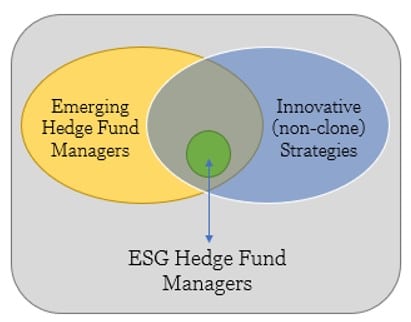
When I think of new and groundbreaking strategies, my mind immediately goes to ESG strategies, likely, because ESG is
where my research has been focused. Nevertheless, these are undoubtedly innovative strategies and include long/short
equity managers that focus on companies that contribute an impact aligning with one or several of the 17 Sustainable
Development Goals, or SDGs, created by the United Nations. There are funds that specifically focus on offsetting
carbon use and greenhouse gases in our atmosphere, as well as funds that solely focus on facilitating the energy
transition from fossil fuels to electricity.
These are not just noble pursuits but are also pioneering hedge fund strategies that the data suggests may lead to
outperformance. Selecting emerging managers comes with its own challenges, but I think this evidence is compelling
enough to allocate resources to the space. If you allocate to hedge funds and are still skeptical of the
return potential of ESG hedge funds, then try thinking of them as an emerging manager
with an innovative strategy.
As more resources are funneled into ESG and responsible investing research, we will soon have definitive academic
studies proving that specific ESG factors contribute to alpha. That day is quickly approaching, but until then, a
strong argument can be made for outperformance of emerging ESG hedge fund managers by using the available data and
viewing them through the lens of emerging managers with innovative strategies.
Contact the Author
Gregory Neal, Director of Investments. investments@hfr.com
Learn more about HFR Investments at:
https://hfr-investments.com or e-mail us at investments@hfr.com
A downloadable copy of the article may be found here:
Disclaimer: This article does not constitute an offer, or a solicitation of an offer,
to buy or sell any securities, and is intended for informational purposes only. Any offer of an HFR Fund will be
made solely by a Confidential Offering Memorandum, and then only to qualified purchasers. This document is
confidential and is intended solely for the information of the person to whom it was delivered. It is not to be
redistributed to any third parties without the prior written consent of HFR Investments, LLC (“HFR”).
Opinions, estimates, forecasts, and statements of financial market trends are based on current market conditions
constitute judgment, may prove inaccurate, and are subject to change without notice. Our views, strategies, and
examples may not be suitable for all investors. References to specific strategies are for informational purposes
only, and is not investment advice, and should not be interpreted as a recommendation.
A Confidential Offering Memorandum will set forth the terms of an investment in a fund, including risk factors,
conflicts of interest, fees and expenses, and tax‐related information. Such material must be reviewed prior to any
determination to invest in any of HFR’s funds.
©2020 HFR Investments, LLC, all rights reserved. HFR®, HFRI®, HFRX®, HFRq®, HFRU, and HEDGE FUND RESEARCH™ are
the trademarks of Hedge Fund Research, Inc.
